Avoid your inquiry is delay response, please enter your WhatsApp/Skype along with the message, so we can contact you at the very first time.
We will reply you within 24 hours. If for urgent case, please add WhatsApp/WeChat: +86 16652801818,. Or call +86 16652801818 directly.
*We respect your confidentiality and all information are protected. We will only use your information to respond to your inquiry and will never send unsolicited emails or promotional messages.
Soft ground, mud, gravel, and unfinished roads can stop a standard forklift fast. That means delays, dropped loads, and higher risk on outdoor jobs. A rough terrain forklift solves that by giving you stronger traction, better ground clearance, and safer lifting on tough sites.
A rough terrain forklift is a Class VII forklift truck built for unimproved ground and disturbed construction sites. The best 6T/7T model usually combines 4wd, a strong diesel engine, a stable mast, large pneumatic tires, and enough capacity to move heavy materials safely on rough outdoor terrain.
A rough terrain forklift is not just a warehouse forklift with bigger tires. The key point is simple: these machines are built for outdoor surfaces that ordinary lift trucks should not handle.
Huibang describes its terrain forklifts as purpose-built outdoor lifting machines with strong 4wd traction, sealed heavy-duty axles, and rugged stability for mining, oilfields, and extreme construction. Its 6T/7T model is presented with strong power, efficient four-wheel drive, comfortable ride, and versatile operation. That makes it a very different type of forklift from a warehouse pallet mover.
In practical terms, a standard indoor truck is made for smooth concrete. A rough terrain forklift is made for uneven surfaces, dirt, gravel, and sites that are still under preparation. That is why contractors, farms, rental fleets, and public works teams look at these machines when the ground is rough and the lifting still has to happen.
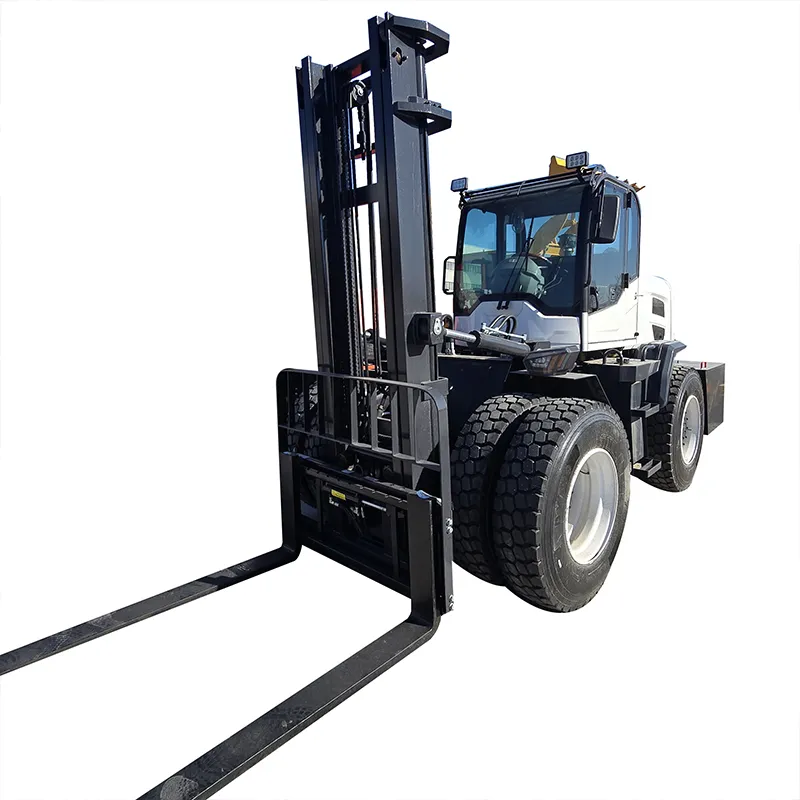
For most heavy outdoor jobs, diesel still makes sense. A diesel rough terrain forklift gives you long run time, strong torque, and easier refueling on remote sites. These machines are built for outdoor work, not quiet indoor warehouse aisles.
A 6T/7T machine also needs power that matches the task. Huibang’s product pages emphasize strong and durable power, efficient four-wheel drive, and suitability for tough environments. When you are handling steel, timber packs, pipe, blocks, or palletized site materials, the strength of the power system matters just as much as the rated capacity.
For buyers in agriculture, forestry, and construction, a diesel forklift often remains the practical choice because it supports long shifts, remote job sites, and quick refueling without depending on charging infrastructure. That is especially useful for outdoor use in wide yards, quarry edges, staging zones, and temporary project compounds.
Because traction is everything on bad ground. 6T/7T model as having efficient four-wheel drive and durable power for versatile operation. When a site is muddy, sloped, loose, or broken up, wheel drive matters more than brochure language.
OSHA’s rough-terrain classification also reflects this reality. These trucks are intended for unimproved natural terrain and disturbed construction areas, not polished warehouse floors. That is why buyers expect pneumatic tires, stronger axles, and higher clearance. Huibang’s blog content adds the same features: large pneumatic tires, rugged frames, and strong engines for safe travel across rough ground.
If I were comparing options for challenging terrain, I would rank traction features this way:
That combination is what makes an all-terrain forklift feel secure instead of nervous on rough surfaces.
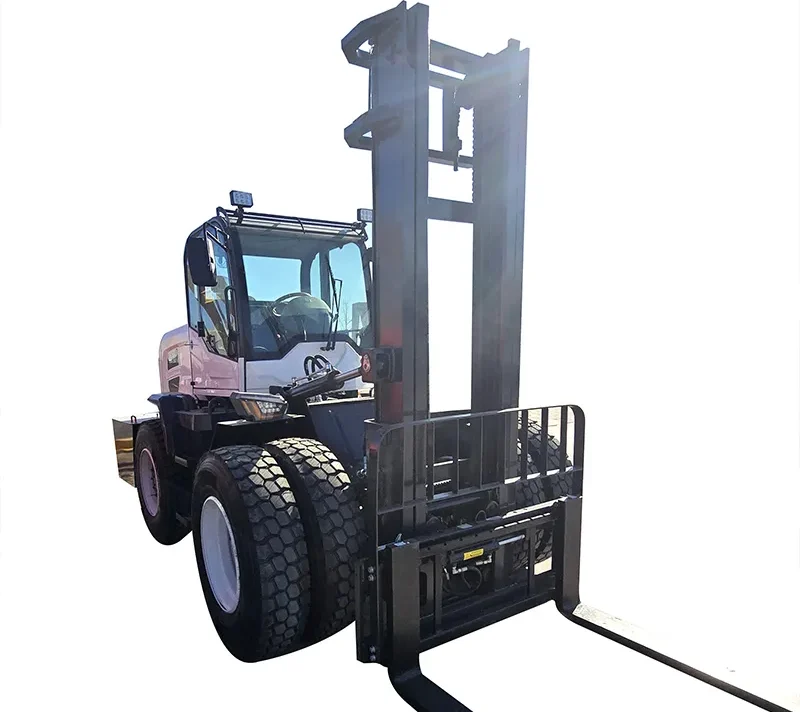
OSHA notes there are three basic types of rough terrain forklift, and the broad market usually divides them into vertical mast machines, variable-reach units, and truck- or trailer-mounted versions. In buyer language, that usually means choosing between mast forklifts and telehandlers.
A vertical mast rough terrain forklift is best when you mostly pick, carry, and place loads in a conventional forward-lift pattern. A telehandler or telescopic machine is better when you need forward reach and placement at distance or height. Huibang’s current 6T/7T product presentation is clearly about a mast-based off-road forklift rather than a telescopic handler.
That means the choice depends on the work. If you mainly transport building materials, pallets, bundled goods, pipe, or timber around construction areas, a mast-style rough-terrain unit is usually simpler and more cost-effective. If you need reach over obstacles or up into elevated zones, telehandlers may be the better answer.
The mast is one of the most important parts of any forklift. It shapes visibility, lifting confidence, and how the truck behaves when the load rises. On Huibang’s 6T/7T page, the machine is positioned around strong lifting ability, comfortable operation, and heavy-duty field use, which makes mast stability a major buying factor.
Good hydraulic tuning matters just as much. A strong engine with poor lift control still creates rough handling. The best rough-terrain trucks balance lifting speed with control, especially when carrying heavy loads over uneven ground. Huibang’s category page also highlights sealed heavy-duty axles and intelligent traction, which support the same goal: controlled movement, not just raw power.
Here is what to verify in a demo:
That is where a rough terrain forklift offers real value: it keeps lifting predictable when the ground is not.
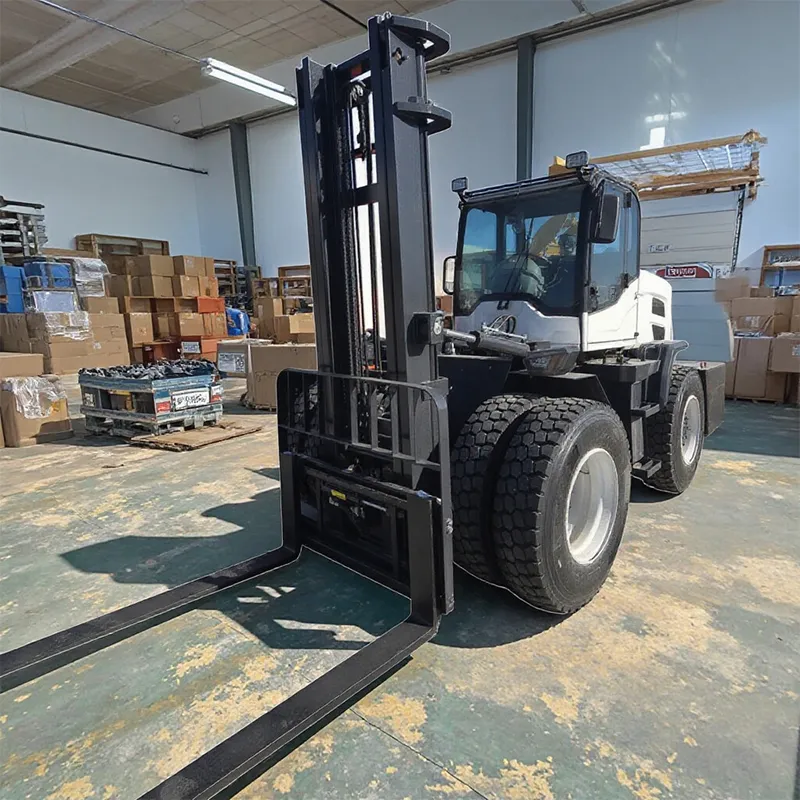
A pallet truck and pallet stacker belong on smooth floors, controlled yards, and indoor logistics. They are not substitutes for a 6T/7T off-road machine. OSHA’s Class VII definition makes that boundary clear: rough-terrain forklifts are for unimproved and disturbed terrain, not for the same conditions as standard warehouse trucks.
A telehandler is closer, but it serves a different purpose. Telehandlers are excellent when forward reach matters. A mast-based rough-terrain truck is stronger when the main job is repeated pick-and-carry movement of heavy materials at lower or moderate lift height. So the right machine depends on whether you need reach or repeated transport.
If your site work is mostly:
That is the simplest way to decide what forklift you need.
A used rough terrain forklift can look attractive on price, but rough-ground work hides wear. Axles, tires, mast channels, steering joints, and frame welds take real punishment in outdoor service. On a machine built for rough and uneven conditions, neglected wear turns into expensive downtime fast.
That is why many buyers prefer a new machine from a manufacturer with a real product line. Huibang positions itself as a high-performance construction equipment maker with rough-terrain forklifts, telehandlers, loaders, excavators, and other off-road machinery. That broader manufacturing base matters when you want parts support and clearer product continuity.
When buyers search, they often compare popular brands or look at auction channels. That is normal. But a brand search does not always answer the real question: who can supply the right truck, with the right spec, and support it properly for your work?
Huibang presents itself as a professional construction equipment manufacturer with a wide product range, including rough terrain forklifts, telehandlers, loaders, mini excavators, electric forklifts, and mixer trucks. That matters for B2B buyers because it suggests deeper application knowledge, export familiarity, and broader material handling solutions than a simple reseller listing.
For contractors, agri dealers, forestry teams, and public buyers, the strongest argument is not just price. It is fit for use: durable design, real off-road handling, good load capacities, and a supplier that understands heavy-duty applications in the field. That is why a factory-direct conversation often matters more than a badge comparison.
A rough terrain forklift is a Class VII forklift designed for unimproved natural ground and disturbed construction terrain, rather than smooth warehouse floors. It is typically used outdoors and built for challenging surfaces.
For most off-road work, yes. 4wd improves traction on mud, gravel, slopes, and broken ground, while 2wd is usually less capable in those conditions. Huibang’s rough-terrain line prominently emphasizes four-wheel drive on its category and product pages.
Huibang’s 6T/7T product page lists rated lifting weight at 6000kg/7000kg, which puts it firmly in the heavy-duty outdoor lifting class for building materials, palletized goods, and site supplies.
They are generally intended for outdoor conditions. OSHA classifies them for unimproved and disturbed terrain, and their size, tires, and diesel operation make them far less suitable than standard indoor lift trucks.
A telehandler uses a telescopic boom for reach, while a mast-style rough-terrain forklift is better for conventional lift-and-carry work over rough ground. OSHA recognizes multiple basic rough-terrain truck types, including variable-reach machines.

 English
  Arabic
  Turkish
  Spanish
  Portuguese
  Russian